User Spotlight:
Nassau, NY — Transforming Regional Emergency Communication Across 1,565 Users
Meet the Leaders Behind the Nassau Region's Success
In Nassau County, NY, transforming emergency communication has been a true team effort. Many dedicated leaders, physicians, and EMS professionals have helped guide this regional project from its early development through its ongoing success including the long-time efforts of Dr. Josh and David Kugler, hospital partners, and regional EMS leadership.
Among those helping move the initiative forward are Dr. David Silver, Medical Director for multiple EMS agencies and Chair of the Nassau REMAC QA/QI Committee, and Don Hudson, EMS Academy Administrator and a REMSCO Council Member.
Dr. Silver, an emergency medicine physician with Northwell Health, began his career as a firefighter and EMT before returning to his EMS roots as a medical director and educator.
“I was a volunteer for seven or eight years, so I’ve been around for a while,” he shared. “I’m an emergency medicine physician by trade. I’ve been out of residency for 14 years, all here on Long Island with Northwell Health.”
Hudson’s path began at just 18 years old in his local volunteer fire department. “I started at 18, joined my local volunteer fire department… went to EMT school, then medic school, and was hired by the City of New York. I worked there for 19 years as an EMS paramedic, Instructor and then Paramedic Lieutenant”, he said. Now, as the Administrator of Nassau County’s EMS Academy, Hudson oversees education and training while helping coordinate region-wide communication initiatives.
Together with a network of regional collaborators, Dr. Silver and Hudson are helping drive a culture of innovation, communication, and teamwork that’s reshaping how Nassau connects care from the field to the hospital.
A Model for Regional Communication
Nassau’s success is more than the rollout of a new tool. It demonstrates what becomes possible when an entire region agrees that communication cannot break at jurisdictional lines. Emergency care is fast, complex, and rarely fits neatly within one organization’s boundaries. Patients move. Incident severity changes. Hospital availability fluctuates. When EMS and hospitals operate on separate protocols, platforms, or expectations, even a minute of delayed communication can set back patient care.
Regional standardization gives every provider, dispatcher, and clinician the same playbook. It means clinicians aren’t just hoping their message gets where it needs to go. They know it will.
Nassau County embraced this belief early. Leaders recognized that if EMS teams could reliably share real-time data and visuals with hospitals before arrival, patient care could accelerate from the very first mile of transport. With e-Bridge, agencies no longer rely on descriptions traveling through layers of intermediaries. They deliver first-hand insight instantly.
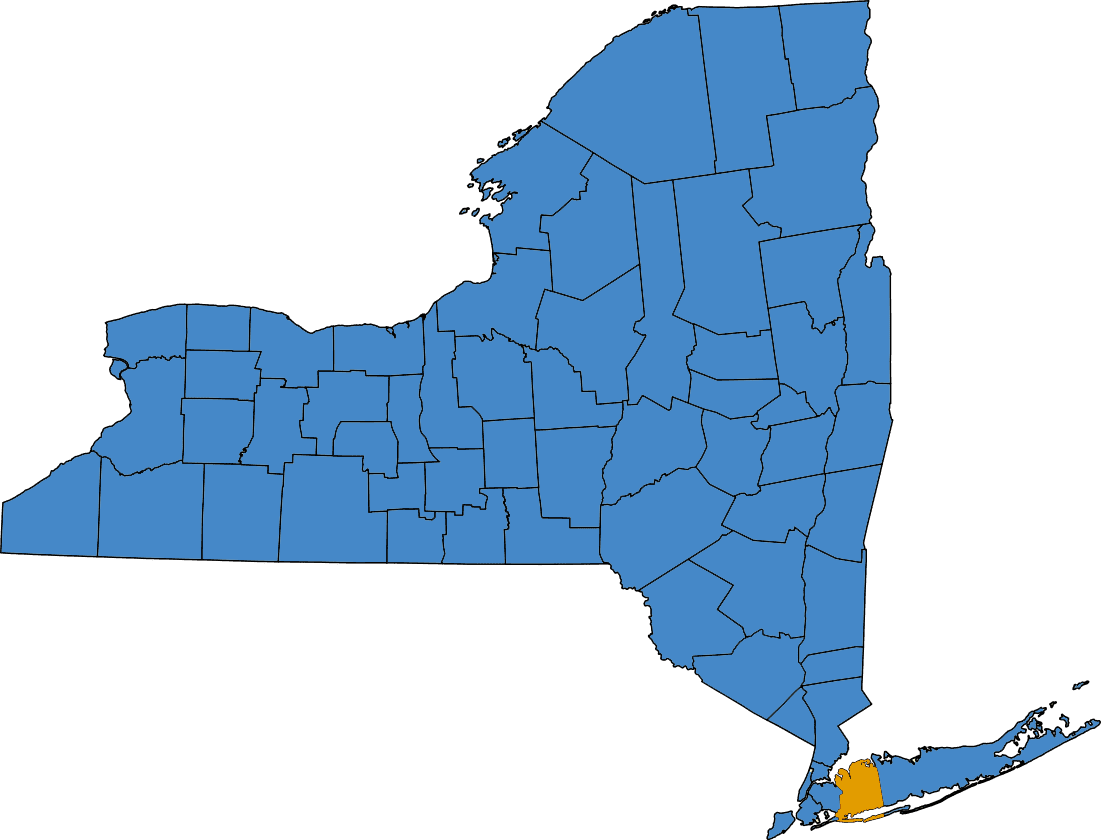
Nassau County
As Hudson reflected:
“Since the seventies, we’ve been trying to train people to ‘paint the picture with your words. Well, if a picture’s worth a thousand words, what’s a video worth?”
The region’s approach creates a unified ecosystem: one regional network, one communication standard, many hands working together. The result is one of the largest and most connected mobile telehealth deployments in New York State and a model for regions nationwide.
Fast Facts: Nassau County e-Bridge Program
Region
Nassau County
Long Island, NY
Key Focus Areas
Stroke, Trauma, and System-Wide Prehospital Notification
Impact
Improved pre-notification accuracy, reduced communication delays, and increased buy-in across agencies
13
Hospitals
Connected
84
EMS Agencies
Using e-Bridge
1,565
Active Users Across
Nassau County
The Need for e-Bridge Across the Region
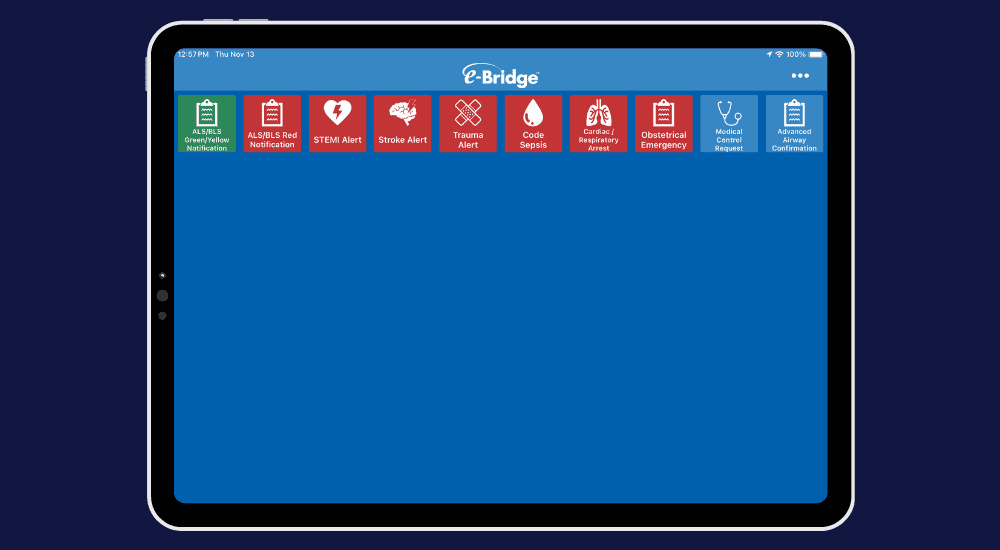
Before e-Bridge, Nassau’s EMS-to-hospital communication relied heavily on radio transmission. It worked, but only to a point. Information often passed through multiple hands before reaching the emergency department, and by then, the finer details could be diluted, delayed, or lost entirely. As Hudson explained:
“Our radio-based medical control was not directly to the hospital. So, when Dr. Silver says we have played telephone, it was literally a second or third-hand information that the hospitals were getting.”
In an environment where minutes mean the difference between walking out of the hospital or a lifetime of impairment, uncertainty simply wasn’t acceptable. Critical data like suspected stroke symptoms, changes in vital signs, or evolving trauma concerns needed to travel faster.
Hospitals needed a clearer picture earlier. And EMS needed a way to communicate without juggling equipment or hoping someone on the other end caught every word.
Across local agencies, leaders saw similar frustrations:
- Communication delays when hospitals were busy or radio traffic was heavy
- Difficulty confirming that messages were heard and understood
- No ability to share images, video, or diagnostic insights
- Limited visibility into which patients were coming and when
The region was ready for a system that didn’t just notify hospitals but connected them in real time.
That desire for stronger, more unified collaboration brought together Nassau EMS Leadership (REMSCO/REMAC), and all the hospitals in the Region. Their shared mission: eliminate fragmentation and build a connected digital communication network that puts the patient at the center of every exchange.
Through this coordinated effort, the region successfully linked all 84 EMS agencies and 13 hospitals through the e-Bridge platform, creating one of the most comprehensive regional deployments in the state. More than 700 providers across the region now use e-Bridge, along with Northwell EMS’s structure of 865 individual users, each equipped to communicate directly and consistently.
Hudson highlighted the transformation simply:
“Every hospital is using it, every EMS agency’s using it in one way, shape, and form.”
The telephone game is finally over. In its place: a real-time, visual, and collaborative connection that ensures every patient story arrives without interruption.
How Nassau Uses e-Bridge Day-to-Day

Today, e-Bridge plays a central role in Nassau’s EMS communication and hospital preparedness. Dr. Silver shared how the system transformed workflows:
“In Nassau County, prior to e-Bridge, there were still notifications of every call that was supposed to be going to a hospital called through our medical control, and we would get notified on a red phone. This way, we’ve been able to not only be notified directly of pretty much anything coming our way but also give us the opportunity to talk back, whether it be a chat or real-time.”
At Glen Cove Hospital, where Dr. Silver serves as EMS liaison, e-Bridge enables his team to see who’s calling ahead, communicate directly, and prepare for patients before arrival.
For stroke care in particular, e-Bridge has been instrumental in improving pre-notification and coordination.
“We were able to get all of these stroke coordinators from the Nassau County
hospitals in one room,” Dr. Silver said. “Once we got in there, we were able to really get an idea of what these stroke coordinators are looking for.”
The outcome was a redefined stroke workflow with required data fields including age, glucose, stroke scale, blood pressure, and a finger stick. These additions ensure hospitals receive critical, standardized information in every notification, supporting faster code stroke activation and ultimately improving patient outcomes.
“Even if you save two or three minutes, that two or three minutes is millions of neurons,” said Dr. Silver.
Driving Buy-In from Providers
As with any new technology, encouraging adoption requires persistence and purpose.
“That has always been something from the beginning with e-Bridge that we’ve had
to deal with, ” said Dr. Silver. “You have a lot of providers who have become accustomed to picking up the radio, giving a notification, and being done with it.”
Rather than enforcing compliance, the Nassau County team emphasized education and patient benefit.
“We introduced the stroke project as not ‘we’re giving you more to do,” Dr. Silver continued. “We brought it over as, ‘This is an idea to improve the care of the patients you’re taking care of.’ If I knew that by getting this person into the CAT scan or their drugs faster, I’m making a huge difference in their outcome, then people are less upset about doing it.”
Hudson agreed, adding that buy-in strengthened once hospitals voiced their support.
“Our win came from the hospitals driving this, the hospitals paying for it, and the hospitals desiring it. As that message spreads that this isn’t just an EMS thing, this is good for patients… as people see how everyone else is using it and see that it’s working, they sort of become a little bit, you know maybe I should give it a try.”
Month over month, e-Bridge notifications across the Nassau Region continue to rise, with more agencies integrating it into daily operations and even former skeptics becoming advocates.
“We’re seeing increases every month,” said Dr. Silver. “We’re having people convert some of the initial naysayers now come in and say, ‘I hated e-Bridge when it started, I did not want to touch it. But now I see its value.’”
Change, especially in high-stakes environments like emergency medicine, doesn’t come easily. When every call is unpredictable and every second is precious, consistency offers comfort and anything new can feel like a risk. Yet Nassau County’s story shows that when innovation is rooted in trust, supported by leadership, and clearly tied to better patient outcomes, even the most seasoned providers can see the value in evolution. In time, what once felt unfamiliar becomes second nature and what began as a challenge becomes a region-wide success story.
The Power of Visual Communication
For Nassau County providers, e-Bridge’s video capabilities have proven invaluable in critical cases.
“When I flip that camera on, he’s like, ‘My God that’s life-changing for the patient,’”said Hudson. “That’s what it is really all about, patient care.”
Dr. Silver added that even brief live video can transform hospital readiness:
“We’ve been trying to tell them, look, if you need your hands and you’re busy, push the call button. Leave the iPad. Let me see the roof of the ambulance. Now, as the receiving hospital, I can talk to you directly.”
This visual connection replaces the old “telephone game” with transparent, real-time collaboration among EMS, medical control, and hospital teams all focused on improving patient outcomes.

Collaboration, Support, and What’s Next
The success of Nassau County’s implementation has been supported by strong partnerships and responsive support from GD.
“Having a single point of contact within GD was essential,” said Hudson. “We were dealing with Chelsea literally on a daily basis, and she was phenomenal. Not only internally, but if she didn’t know how to do something immediately, she put us in touch with somebody who did. Being an EMS provider, she knew us and we spoke the same language, it really streamlined things.”
Dr. Silver echoed this, noting GD’s quick response and collaboration.
“Everything we’ve ever needed on the hospital side… I haven’t gotten a ‘no’ yet or a ‘we won’t try.’ Communication happens quickly.”
See Some of Our Additional Resources Below!


Mercy Medical Center
Lorem ipsum dolor sit amet, consectetur adipiscing elit. Ut elit tellus, luctus nec ullamcorper mattis, pulvinar dapibus leo.

Renee Rochette
Lorem ipsum dolor sit amet, consectetur adipiscing elit. Ut elit tellus, luctus nec ullamcorper mattis, pulvinar dapibus leo.